

General Tips on Praesten and OGP Bulldog
Through-line spoons like the Praesten, as well as hangers like the OGP Bulldog, are becoming increasingly important in trout lakes. In Denmark, these have long ceased to be secret weapons; they are now standard equipment for every trout angler.
But when and, most importantly, how do I use this lure correctly, and what tackle is needed for this fishing method?
First, let's talk about the tackle:
A reel size of 2000-2500 is recommended, as these lures are somewhat heavier than conventional spoons and allow for long casting distances. The larger spool creates less friction during the cast, allowing the lures to achieve their optimal flight path. Whether the reel is from Daiwa or Shimano, and whether it costs 60 Euros or 400 Euros, is of secondary importance. The reel should simply fit your budget.
I personally use the Daiwa Steez Type II, which is more of a high-end reel. However, a Daiwa Ninja or Daiwa Exceller, Shimano Stradic or Daiwa Ballistic or Daiwa Luvias would also be good choices here.
For the rod, casting weight and length are the decisive factors. Of course, there are also personal preferences that should be considered when buying a rod. Nevertheless, the rod should have a length between 200cm and 240cm and a casting weight of 2-10g. But why is this so important? The casting weight gives you an indication of the range in which the rod blank has and releases its optimal loading characteristics. For the specified 2-10g, this range should be around 3.5-8g. This covers a wide spectrum of Praesten and Bulldog lures. The length is crucial for guiding the lure and for casting distance. The rule of thumb here is: the longer the rod, the greater the leverage. And the greater the leverage, the further our lure flies under optimal conditions. For guiding, it is crucial for the following reason: with the position of the rod and the retrieve speed, I can strongly influence the running depth of the lure. A rod held high (10 o'clock) with normal retrieve speed will make the lure, whether 7g or less, run rather shallowly just below the surface. If I only reduce the retrieve speed, the lure will run about 30-50cm below the water surface. Thus, by varying the rod position and retrieve speed, I can fish all water depths where I suspect the fish to be.
For this type of fishing, I personally use the Herakles Elysium Wild in 240cm with a casting weight of 2-10g. The Praesten Reaper, which was specially designed for this type of fishing, also performs excellently. But as with any rod, personal preferences should always be included here.
So, we've covered the rod and reel; now let's talk about the line. Here, I like to use braided lines, especially Japanese lines. These are not specified in mm like German lines, but in PE. In Japan, lines are weighed, and this results in the PE specification. For fishing with Praesten and Bulldog, I use a line with PE 0.3 to PE 0.4. These usually have a breaking strength of around 6-8 lbs, which corresponds to approximately 2.3-3.3 KG. Here, too, the range is enormous. The advantage of braid is that it has almost no stretch and is thinner than monofilament line. Furthermore, it has better unrolling properties from the reel, thus achieving greater casting distance. However, monofilament line can also be used equally well.
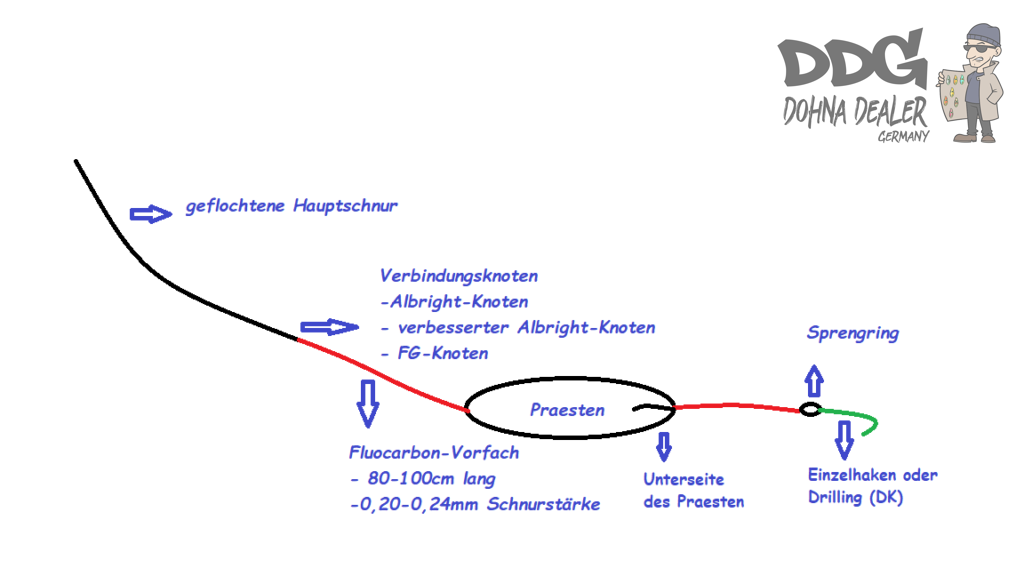
So, the bulk of our tackle is set. If we're fishing with braid, it's advisable to attach a fluorocarbon leader in front of the lure. This reduces spooking and abrasion compared to a direct connection to the main line. The leader should be about 80cm – 100cm long and have a thickness of 0.20-0.24mm (0.20mm = 3.5g and 0.24mm = 7.0g). Many will surely ask why so long and so thick? This is very easy to explain. The thickness of the leader should be chosen so that the lure can just barely run freely on the line. This ensures that the leader cannot kink and that pressure and friction on the leader are minimized. The length is due to the fact that when changing lures, you remove the hook tied with a split ring, thread on the new lure (thicker end with hump facing down), and re-tie the hook to the split ring (the split ring here merely serves to keep the hook freely movable). Another advantage of a long leader is that the lure has more room to slide up the leader during the fight. This minimizes pressure on the hook and greatly reduces the chance of the fish coming off.
Finally, a quick word about the hook. The hook is attached to the leader using a split ring, allowing it to move freely. In Denmark, trebles are predominantly used. In Germany, these are usually forbidden. Therefore, single hooks are used here. For the 7.0g model, single hooks and a split ring together should weigh approximately 0.35g. This is the weight of the corresponding treble hook. If the single hook is too light, weigh it down with a 2.5mm tungsten bead. Otherwise, the action of the 7.0g model will be significantly affected.
I personally upgrade the Bulldogs to the VanFook SP-41 MB or BL. For the 7.0g models, hook size #2 is recommended, and for the 4.0g models, hook size #4. These hooks are very strong and ultra-sharp. For the Praesten in Germany, I also use this hook. In Denmark, I like to fish it with a treble. Here, you can use ready-made solutions including split rings directly from Praesten.
Now that you've read enough, let's move on to a visual representation of the rigging.