


FischUP Pupa
– Small bait, big results –
The perfect bite for the really big ones.
Today, I'd like to introduce you to the FishUp Pupa. It's currently available in 14 different colors and 3 sizes: 0.9", 1.2", and 1.5". My preferred size is 1.2" because the bait is designed to imitate a bee larva. For normal portion trout and salmon up to 3 kilos, I prefer the 1.2" version. When targeting the really big "moms," a slightly larger bite can be better, so I use the 1.5" version then.
The bait is fished on a size 6 or 4 hook. I generally prefer hook size #4.
The bait is equally suitable for both passive and active fish. I will go into more detail on this below.
- Rigging for passive fish
When the fish are rather sluggish and passive and are close to the edge, you can sight fish the Pupa on a tungsten hook with a very small or even no tungsten bead. For this, I thread the Pupa straight onto the hook and try to entice the fish by letting the bait sink in front of their mouth. Often, the bite comes then. It's not the most exciting way to fish, but sometimes it's effective.
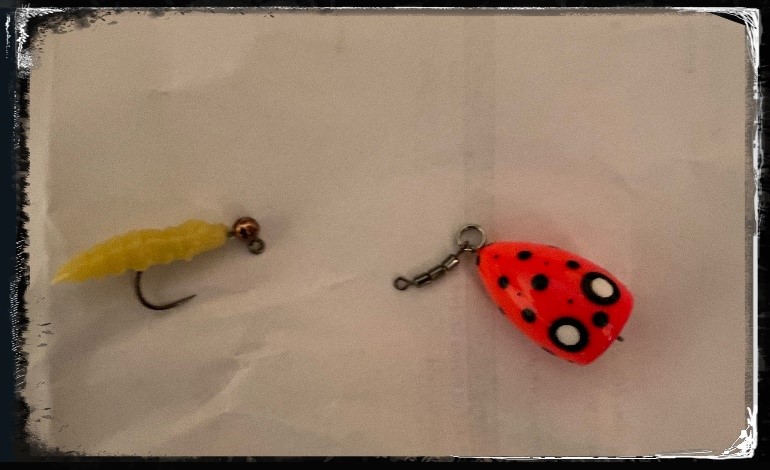
If the fish are rather sluggish and passive and not close to the edge, an aid is needed. This is where the Popla Popper from Viktor Omelchenko comes into play. It's available in different colors and 2 weights. This is attached to the snap, and a leader (which can be chosen freely, depending on the depth to be fished) is tied to the other end. Finally, the hook is attached using a Rapala knot. The Rapala knot is a loop knot from fly fishing that allows the hook to move freely. If necessary, the hook can also be fitted with a small tungsten bead. Here too, I thread the Pupa straight on. The advantage of this rig is its flexibility. I can fish the rig stationary or retrieve it with light twitches. A combination of both is usually most successful.
- Rigging for active fish
With this rig, I can also fish the Pupa solo on a tungsten hook. Here I usually use medium to large tungsten beads (depending on the depth of the fish). However, for active fish, I thread the Pupa in a slight L-shape. This makes it rotate, which drives the fish crazy. What worked for the good old natural bee larva also works perfectly here. I use this rig when the fish are in open water (mid-water to bottom).
However, if the fish are shallow and still active, the popper comes into play again. We proceed exactly as with the rig for passive fish, but we thread the Pupa in an L-shape and retrieve the rig evenly or combine it with light twitches and let the Pupa sink again in between. Often, the bites come precisely during these sinking phases.
Here are a few more pictures of a straight-threaded Pupa and one threaded in an L-shape.
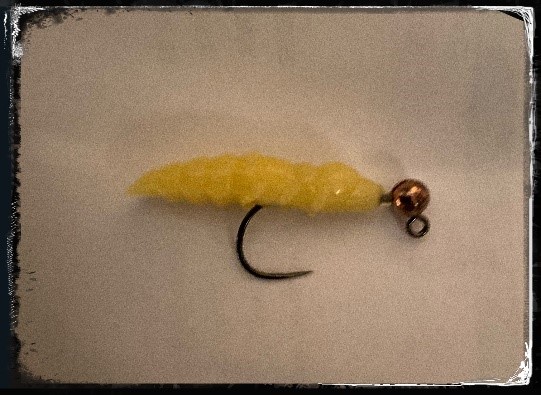
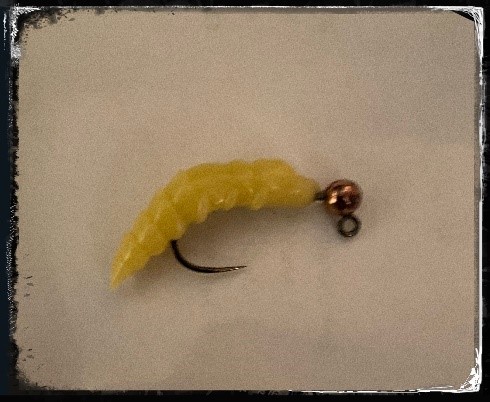
Here's another picture of the Popla Popper. I often use the 3.7g version here. Furthermore, for active retrieves, I use a triple swivel, as the main line would otherwise twist severely due to the rotation.
I hope you enjoyed my article. If you have any questions, please don't hesitate to ask. I'm happy to help.


