


The Polarized Glasses Guide – Not all polarized glasses are created equal!!! – It's the inner values that count.
Are you looking for the perfect companion for your fishing trips or other sporting leisure activities? Then you should read this guide carefully. Because there are a few things to consider when choosing the perfect pair of polarized glasses. Let's start with the most important.
Sunglasses vs. Polarized Glasses
Normal sunglasses protect the eyes from excessive light and harmful UV radiation (UVA and UVB). The result is that seeing with these glasses in bright sunshine feels much more pleasant.
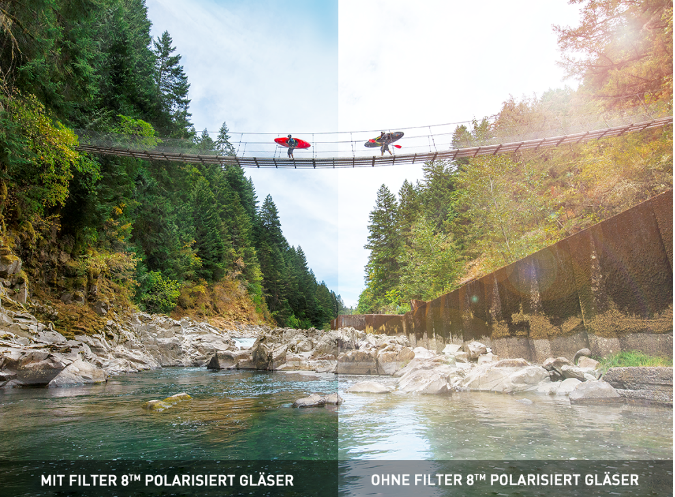
Polarized glasses also have these capabilities, but they are distinguished by their ability to additionally block horizontal light reflections. These occur when light rays are reflected from non-metallic surfaces, such as water. This filter effect of polarized glasses allows us to see very well and, above all, deep into the water, so we can often spot one or two more fish.
Another positive side effect is that we can look at the water much longer with polarized glasses.
The filter makes the difference and provides clear vision.
The Right Model for the Right Type
In the past, polarized glasses were rather drab and boring, and more functional. However, manufacturers are moving with the times, and there are now many stylish models. But amidst all the chic, one thing should not be forgotten: polarized glasses are only truly functional if they shield the eye from light from all sides as much as possible and at the same time restrict the field of vision as little as possible.
But even here, there are already innovations. The company Wiley X, for example, works in this area with a special anti-reflective coating on the inside of the lenses to avoid irritating reflections.
 What color should the lenses be?
Generally, the property of polarized glasses is not dependent on the color of the lenses.
However, there is a small rule of thumb to follow. On bright, sunny days, it's better to choose darker lenses. Copper-colored, amber-colored to grayish lenses are recommended here. These do not strain the eyes as much in these lighting conditions, and the eye does not tire as quickly due to the reduced effort. On overcast days, you should clearly opt for light lenses to enhance the residual light. Light blue or yellow lenses are highly recommended here to achieve the same effect of fatigue-free fishing. Therefore, it is always advisable to have two models in your bag.
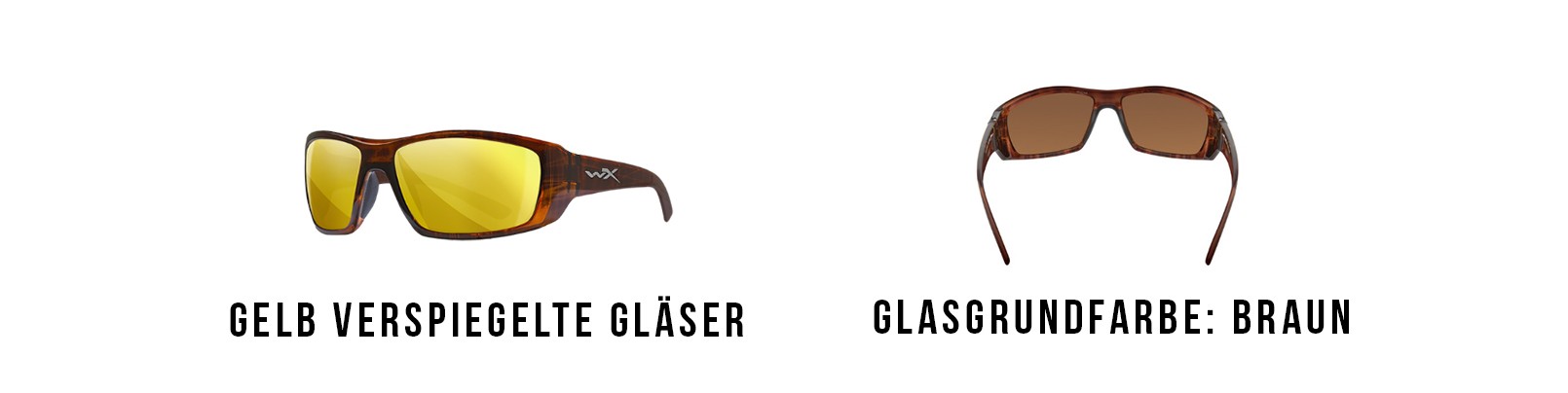
And please do not be guided by the mirroring of the lenses. The base color of the lenses should be described separately for every good pair of polarized glasses. The mirroring is more important for image sharpness and better contrast and also makes the polarized glasses look more stylish.
 A good pair of polarized glasses should cost enough to meet your needs. You determine the price range yourself, but there are good arguments for choosing a high-priced model.Expensive vs. Cheap
Firstly, it should be noted that the polarizing filter used in all glasses is constructed identically and achieves the same effect. There are no differences here. The differences lie clearly in the workmanship and the interaction with other properties. In most inexpensive glasses, the polarizing filter is applied as the outermost layer on the lenses. This has the disadvantage that over time it wears off gradually through cleaning the glasses. (There are always small dust particles in the air or on the cleaning cloth that act like sandpaper for the polarizing filter over time)
1. In high-quality models, the polarizing filter is protected and embedded in the middle.
Here is the construction of a lens of a Wiley X polarized glasses with Filter 8™:
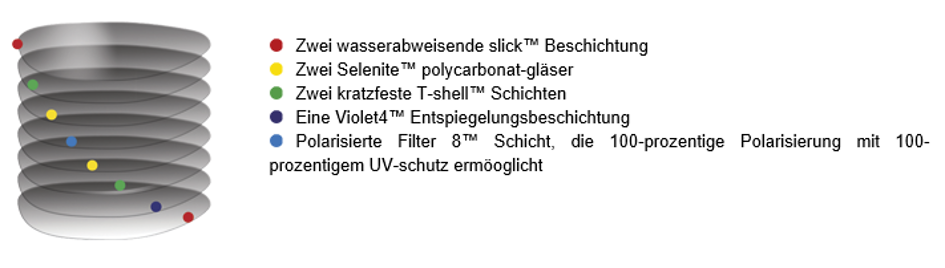
This onion-like structure protects the polarizing filter and offers further positive properties (additional anti-reflective coating (inside), extra scratch resistance).
Here's the comparison:
2. Another, and for me very important, reason to choose high-quality polarized glasses is the shatter resistance of the lenses.
Every angler among you has probably experienced this situation:
You're reeling in a fish, and the fish and lure are getting closer, euphoria builds, and suddenly the lure slips out and flies towards you at breakneck speed. You can't react that fast, and in the worst case, the lure shoots directly at your glasses. This can have very serious consequences, including vision loss.
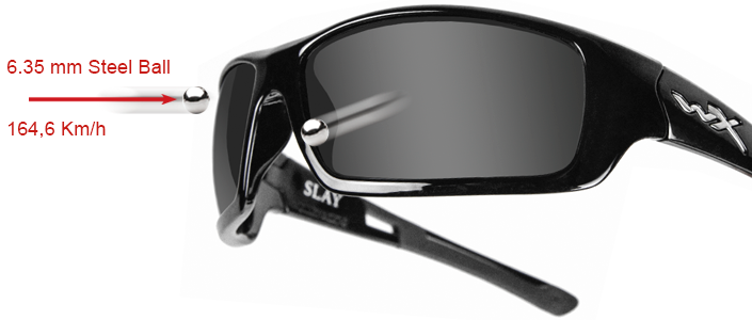
High-quality glasses (like the Wiley X shown here) are designed to withstand such forces well. This has already saved many an angler from worse.
3. And last but not least, it should be mentioned that many manufacturers of high-quality polarized glasses offer the service of providing their glasses with prescription lenses for spectacle wearers upon request. This eliminates those "ugly" and bulky overfit glasses for spectacle wearers.
Wiley X has been working with Shamir for over 10 years, which produces corrective lenses of the highest quality and with the latest technology. Shamir has a unique lens design and a special production process that meets the high demands of Wiley X. The polycarbonate lenses have a thickness of 2.2 mm (+/- 10%) and thus meet the high safety standards for your Wiley X corrective lenses. Eyesight plays a fundamental role in all our activities in life. If your vision is not 100%, you are making compromises. With Wiley X prescription glasses, your eyes are protected and you can enjoy any type of activity.
I hope I have brought the advantages of high-quality polarized glasses a little closer to you. If you still have questions, do not hesitate to contact me.
Tight Lines and always good visibility wishes
Your DohnaDealer


